
For most of his career, Lionel Messi — widely regarded as one of the greatest footballers ever — carried one unanswered question: could he win the World Cup? In December 2022, in Qatar, he finally answered it. This is the story of a journey defined by heartbreak, persistence and ultimate redemption.
Early Tournaments and Near Misses
Messi burst onto the World Cup scene as a teenager in 2006, scoring on his tournament debut. In 2010 Argentina reached the quarter-finals before a heavy defeat to Germany, and in 2014 the pain deepened: Messi dragged an unfancied side all the way to the final, won the tournament's Golden Ball, but lost the showpiece to Germany after extra time. So close, yet without the prize.
The 2018 Setback
Four years later in Russia, Argentina laboured. They scraped out of the group and were knocked out in the round of 16 by eventual champions France in a seven-goal classic. For many, it looked like Messi's World Cup chance had gone for good.
Redemption in Qatar 2022
The 2022 campaign began in disaster — a shock 2-1 defeat to Saudi Arabia. But Argentina regrouped, beating Mexico and Poland to top the group, then edging Australia, the Netherlands (on penalties) and Croatia in the knockouts. Messi was magnificent throughout, scoring and creating in equal measure.
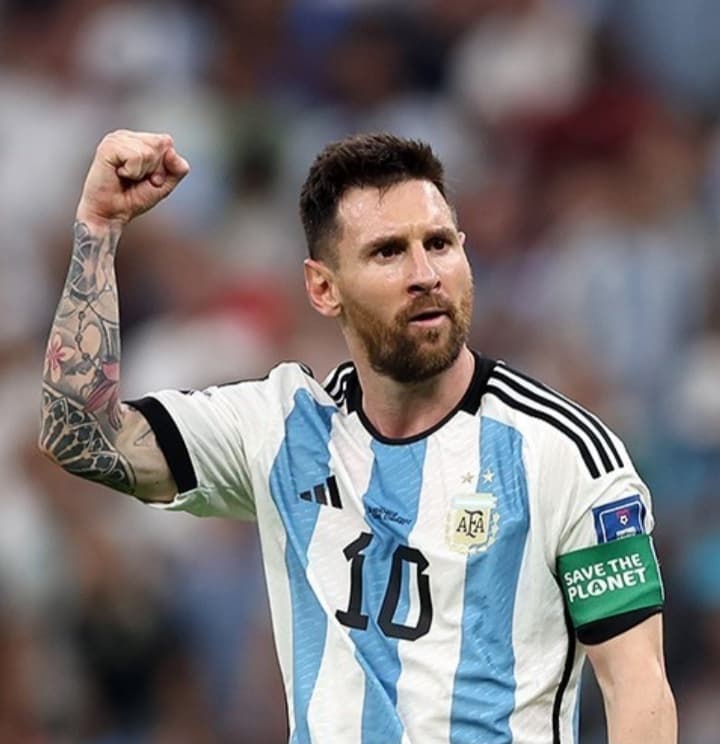
The final against France is regarded as one of the greatest ever played. Argentina led 2-0, were pegged back to 2-2, went ahead in extra time, were caught again at 3-3 by a Kylian Mbappé hat-trick, and finally won 4-2 on penalties. Messi scored twice in the final and was named the tournament's best player.
What It Meant for His Legacy
The title completed the set. Added to his club honours and record number of Ballon d'Or awards, the World Cup silenced the last argument against him and, for many, settled the "greatest of all time" debate in his favour.
Messi's World Cup, by the Numbers
- 5 World Cups contested (2006–2022).
- 13 World Cup goals — among the highest in history.
- 2 Golden Ball awards (best player) — in 2014 and 2022.
- 1 World Cup title, plus a runners-up medal in 2014.
The Long Wait and Argentina's Expectations
Few players have carried a nation's hopes quite like Messi carried Argentina's. In a country that reveres its footballing history, the pressure to deliver a senior international trophy followed him for well over a decade. The burden was sharpened by a run of painful final defeats: beaten in the 2014 World Cup final, Argentina also lost consecutive Copa América finals in the middle of that decade, moments that led Messi at one point to step away from the national team. For years, the debate raged over whether he could translate his club brilliance onto the international stage.
The 2021 Turning Point
The breakthrough finally came in 2021, when Messi captained Argentina to the Copa América title — his first major honour with the senior national side. Ending that long wait appeared to lift an enormous weight from his shoulders. Freed from the question of whether he could win with Argentina, he arrived at the 2022 World Cup as the established leader of a confident, well-drilled team. That triumph is now widely seen as the foundation on which the World Cup success in Qatar was built.
From Prodigy to Captain
Messi's role within the Argentina side evolved dramatically over his career. The teenage prodigy of 2006, deployed as an attacking spark, matured into the team's captain, creative hub and emotional leader. By 2022 he was as likely to drop deep and orchestrate play as to score himself, guiding a younger group of teammates who visibly rallied around him. That blend of individual quality and generous leadership was central to how Argentina navigated the tournament's tightest moments.
His Place in the Argentina Pantheon
Victory in 2022 invited comparisons with Diego Maradona, the icon who inspired Argentina's 1986 triumph and remains a national hero. Rather than settling an argument, the World Cup allowed Messi to stand alongside Maradona in the country's affections — two very different players, from different eras, each having delivered football's greatest prize. For many Argentinians, the achievement secured Messi's status as one of the most beloved figures in the nation's sporting history.
Frequently Asked Questions
When did Messi win the World Cup?
In 2022, captaining Argentina to victory over France in the final.
How many World Cup goals does Messi have?
13, scored across five tournaments.
Key Takeaways
- Messi endured years of near-misses, most painfully the 2014 final.
- His 2022 triumph capped one of football's great individual stories.
- The trophy cemented his place among the sport's all-time greats.